For some people, just having warm shower water in the camper isn't enough — they want it perfect. Our customer Andreas is exactly that type: with a serious tinkering streak, he completely overhauled the Alde hot water system in his Flair 2. Here's how he did it. And if you're more the "it should just work" type: Pundmann also offers ready-made automation solutions for camper hot water systems that run straight out of the box ;-)
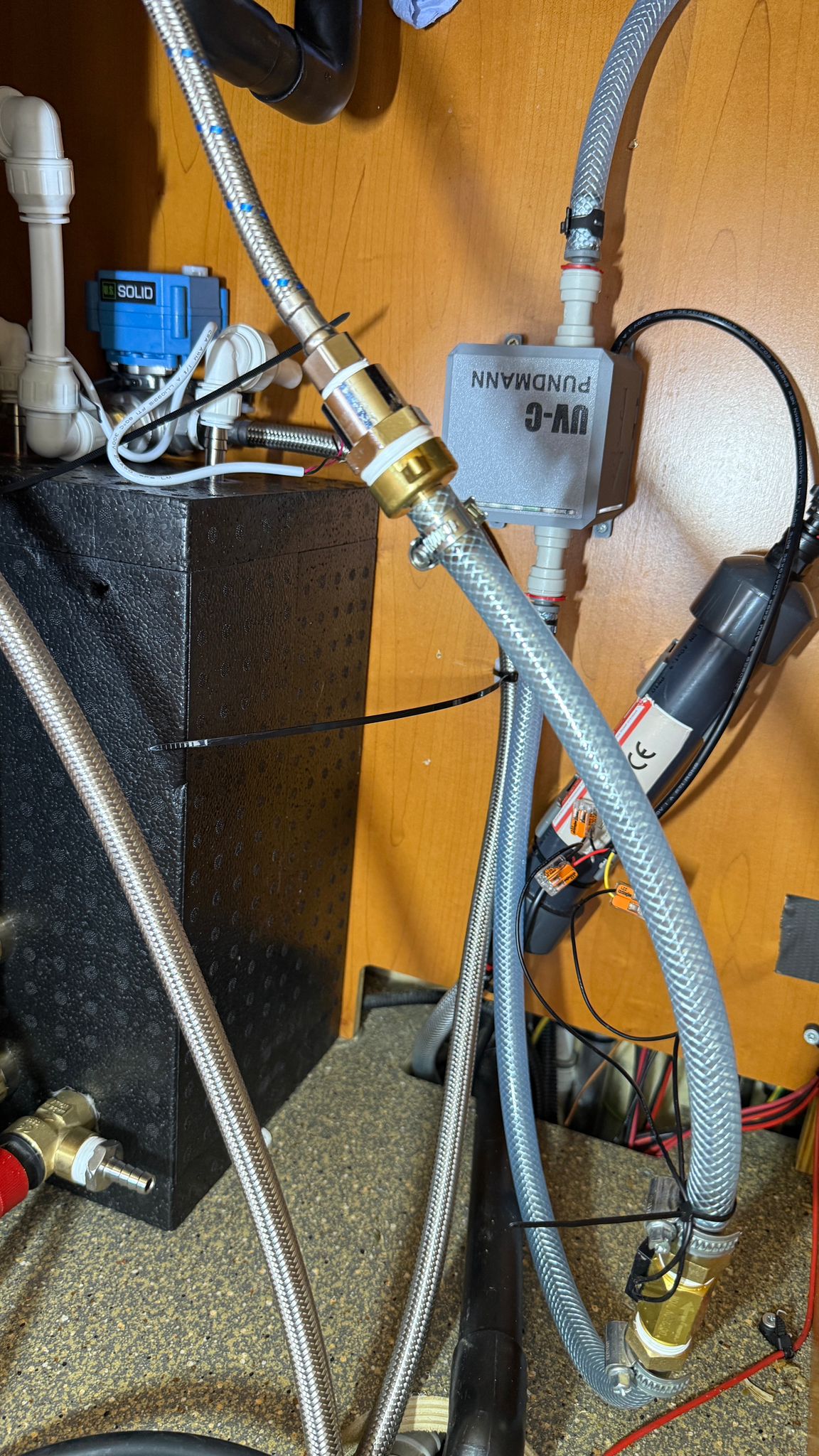
Here's Andreas, in his own words, on how he built it:
Starting point
Since we often travel off-grid and I wanted to spare the Alde unit as much as possible, I rebuilt my motorhome's entire hot water system and automated it with Home Assistant. My goal was to have cheap hot water available at all times, automatically drawn from whichever energy source is currently the most affordable — and at the same time to significantly increase the available hot water volume without burning any extra gas.
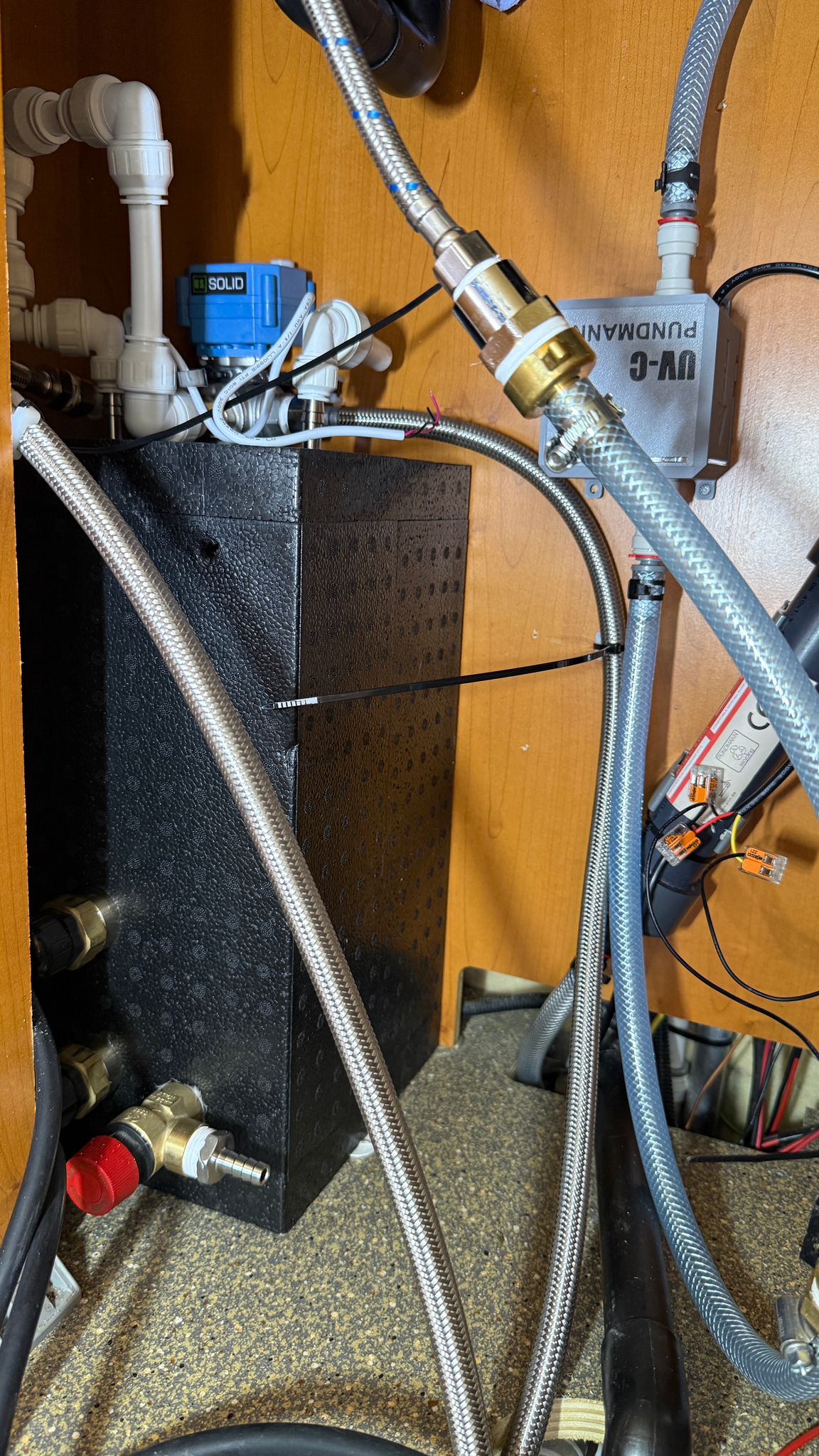
I'm running an Alde 3000 water heater plus an additional insulated 6-litre stainless steel boiler from Pundmann. The boiler has two separate 230V heating elements rated at 500 watts each. Each element is switched via its own Shelly 1 Plus and can be operated independently of the other.
Power comes from:
- 1,400 Wp solar array
- 900 Ah LiFePO4 battery
- Victron MultiPlus II 3000
- Victron charge booster
- Shore power connection
- Engine heat exchanger
Home Assistant handles the entire control logic.
Intelligent boiler control
The first 500-watt element serves as my base heater, the second as a boost heater. Depending on which energy source is available, Home Assistant automatically decides whether to heat with 500 or 1,000 watts.
Hot water while driving – As soon as the ignition is switched on and the charge booster is active, the first heating element switches on automatically. Some of the energy available while driving is converted straight into hot water. Once the house battery reaches a state of charge above 85%, the second element kicks in too, raising output to 1,000 watts — putting surplus energy to good use instead of leaving the battery sitting at a high charge for longer than necessary.
Using solar surplus – If the solar array delivers more than 600 watts, both heating elements activate automatically. The solar surplus goes straight into hot water production. On sunny days, hot water is essentially free, without putting any extra strain on the battery.
Shore power operation – When connected to shore power, both heating elements are activated by default. There's one special case I had to account for: if the Alde is currently heating electrically, both boiler elements switch off automatically. The Alde's electric heating draws around 2,000 watts — combined with both elements that would add up to roughly 3,000 watts, enough to trip the breaker at many campsites. Once the Alde reaches its target temperature and stops heating, the boiler elements are released again.
Temperature monitoring – The boiler heats up to a maximum of 55 °C, at which point both elements switch off. If the temperature drops below 53 °C, hot water production starts again automatically — a small hysteresis that prevents unnecessary switching on and off.
Presence and time control – Hot water production only happens when it's actually needed. Boiler heating stays deactivated between 6:30pm and 9:00am, and I also switch it off whenever nobody is in the motorhome. That avoids unnecessary energy consumption.
Using engine heat
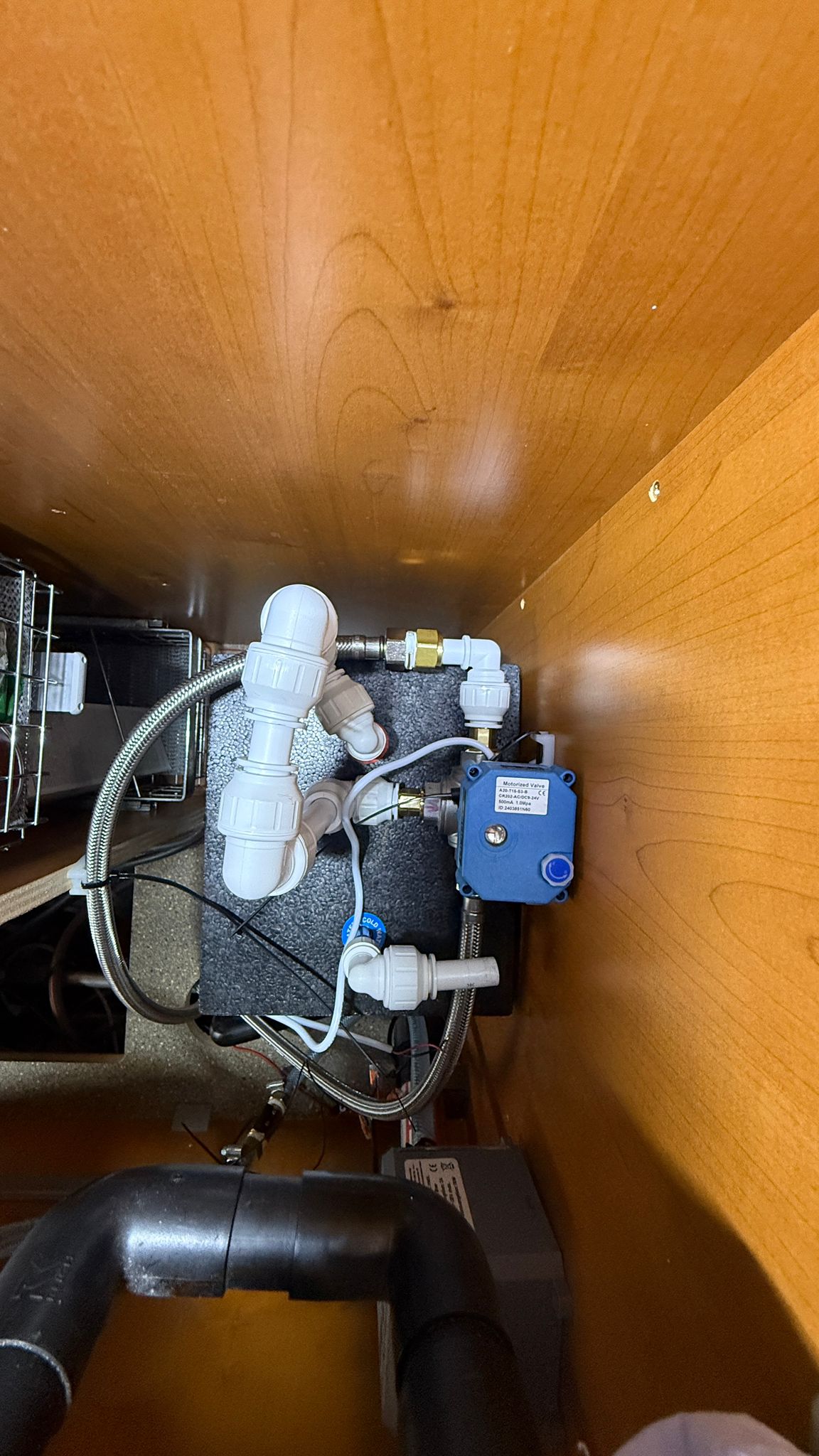
Another piece of my system is putting otherwise wasted engine heat to use. To capture it, I connected the Alde to the engine cooling circuit via a heat exchanger, and added a motorised ball valve and a circulation pump — both also controlled by Home Assistant.
While driving, the heat exchanger and circulation pump activate automatically when the ignition is on, the outside temperature is below 15 °C, the inside temperature is below 19 °C, and the engine coolant temperature is above 50 °C. Engine heat that would otherwise go to waste gets transferred directly into the Alde heating circuit.
The result: my motorhome heats up essentially for free while driving, and the Alde's hot water content warms up at the same time — without using any gas or electric heating elements. After longer drives, I often already have hot water available before I even reach a campsite.
Automatic switching between boiler and Alde
I also installed a motorised 3-way valve. It automatically decides whether hot water comes from the small Pundmann boiler alone or is routed through the Alde boiler as well.
Small boiler alone – If the Alde is off or its water temperature is below 40 °C, the system switches to the small boiler. This gets me hot water quickly without having to run the entire Alde unit — and significantly cuts gas consumption.
Bringing in the Alde boiler – Once the Alde is active or its temperature climbs above 42 °C, the valve switches over and the small boiler's water is routed through the Alde boiler as well. Available hot water capacity increases significantly — especially handy while driving, since the engine heat exchanger has often already preheated the Alde for free.
Both boilers warm – When both the Pundmann boiler and the Alde boiler are above 45 °C, both reservoirs are available together. That gives me almost double the hot water capacity, without using any extra gas — a difference that's especially noticeable in the shower.
Visualisation in Home Assistant
I visualise and monitor the whole system in Home Assistant: active hot water source, temperature of both the Pundmann and Alde boiler, status of both heating elements, and the state of the 3-way valve. Once both boilers are up to temperature, the status automatically shows "Both boilers warm" — so I can tell at a glance when maximum hot water capacity is available.
Conclusion
My system produces hot water almost entirely automatically, preferring free energy sources like solar power, engine heat, or shore power that's already connected anyway. The combination of Pundmann boiler, Alde heater, engine heat exchanger, 3-way valve and Home Assistant gives me a fully automated energy management setup for hot water.
The Alde gets spared, gas consumption drops, and I have significantly more hot water available than with the original setup. After several build stages, this has become one of the most comfortable and efficient upgrades in the entire motorhome.
Don't want to tinker yourself, just want hot water that manages itself? Pundmann's boilerCONTROL is a ready-made solution for exactly this problem — Wi-Fi control, automatic solar utilisation and a battery guard included, straight out of the box. Find out more at www.pundmann.de or get personal advice at m.herbst@pundmann.de.